
Have you ever logged into a massive software platform and felt like you needed a Ph.D. just to navigate the dashboard? We've all been there.
Enter Micro-SaaS.
While tech giants like Salesforce or HubSpot try to be everything to everyone, a Micro-SaaS founder takes a different approach. They pick one specific, annoying problem and solve the heck out of it for a very specific group of people.
Think of it like this: If those massive "all-in-one" platforms are sprawling department stores where you get lost in the aisles, a Micro-SaaS is a local boutique. They don't sell socks, hats, or sunglasses. They just sell the absolute best handmade leather boots in town—and the people who need them are more than happy to pay a premium for that level of focus.
Chances are, it's already in your tech stack.
You might not have known the name for it, but if you look at your credit card statement, you're likely already supporting one. Micro-SaaS is that quiet, $15-a-month subscription that you absolutely rely on. It's:
The slick tool that solely schedules your Instagram reels.
The lightweight app that tracks your freelance hours without the bloat.
The widget that gently pesters your clients to sign their invoices finally.
That's Micro-SaaS in action. It's small, it's hyper-focused, and instead of trying to conquer the world, it just makes your Tuesday a little bit easier.
How Does It Actually Work?
The Micro-SaaS playbook is refreshingly simple. You don't need a master plan to take over the world, just these four steps:
- ●Spot a specific headache: Find an annoying, repetitive frustration in an industry you already know. If it drives you crazy on a Tuesday, someone else will gladly pay to make it disappear.
- ●Build a laser-focused tool: Don't build a massive platform. Build the absolute simplest app that fixes that one specific headache: zero bloat, no useless features.
- ●Charge a fair monthly fee: price it so it's a no-brainer for your users (typically $9 to $299 per month). The math gets fun fast: just 200 users paying $49/month is nearly $10,000 in monthly recurring revenue (MRR). That's a full-time income from a side project.
- ●Keep them ridiculously happy: Your biggest goal isn't just chasing new signups, it's treating your current users so well they never want to cancel. Keep them around, and your revenue compounds month after month.
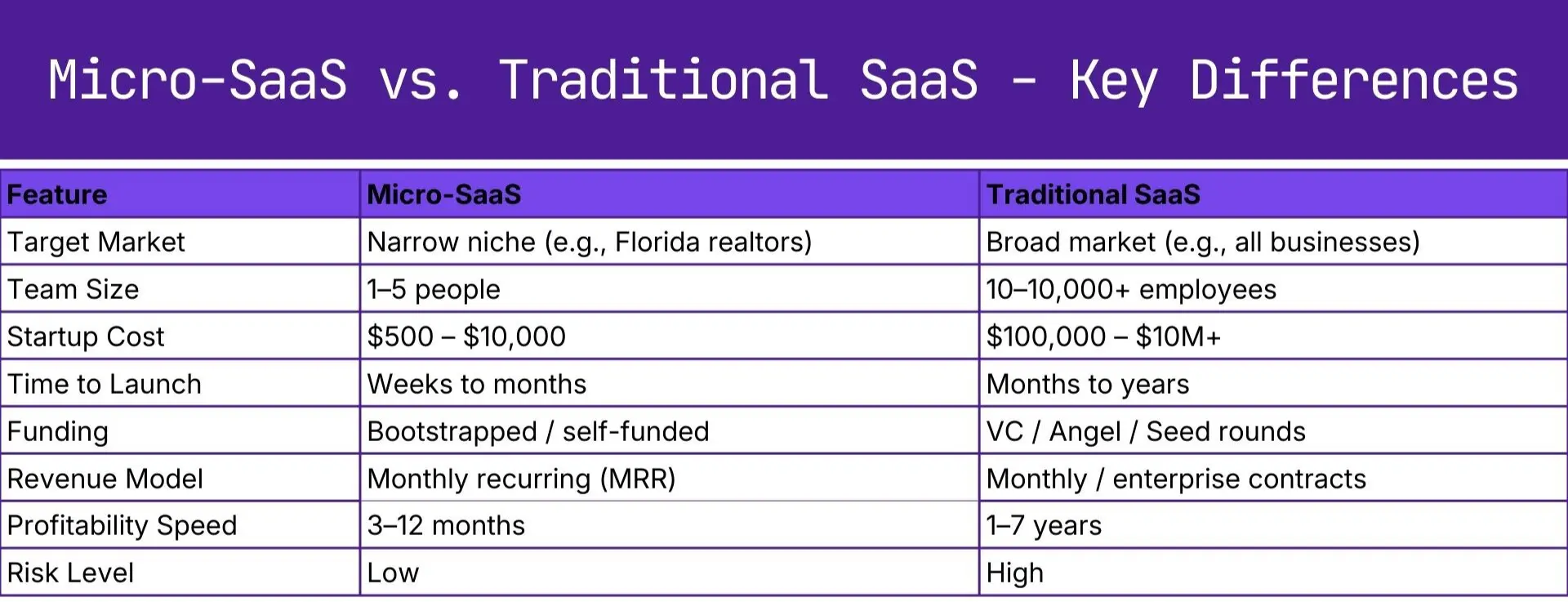
Micro-SaaS vs. Traditional SaaS - Key Differences
Micro-SaaS in the Wild (Real-World Examples)
You'll find these hyper-focused tools hiding in plain sight across almost every industry. Here's what Micro-SaaS looks like when it's out in the wild, solving real problems for everyday businesses:
- ●The Realtor's Assistant: A background tool that instantly emails fresh property leads from big listing sites, ensuring independent agents never let a hot prospect slip through the cracks.
- ●The Restaurant Reputation Saver: A neat little app that monitors Google and Yelp reviews and uses AI to draft polite replies—saving exhausted owners from staring at their phones after a busy dinner service.
- ●The Airbnb Pricing Brain: A bot that quietly tweaks nightly rates based on local demand and events, squeezing out extra profit for vacation rental hosts while they sleep.
- ●The No-Show Killer: A dead-simple SMS tool for dental clinics that politely pesters patients about upcoming appointments, saving the practice thousands of dollars in lost chair time.
- ●The Legal Paperwork Untangler: A secure document-chasing and e-signature app built entirely around the notoriously messy onboarding workflows of small law firms.
- ●The Compliance Watchdog: A visual dashboard for construction crews or nursing teams that flashes red before a crucial employee certification or license actually expires.
Why Your Business Needs Micro-SaaS
It doesn't matter if you run a bustling local bakery, a real estate agency, or a plumbing crew—swapping out clunky software for a few hyper-focused Micro-SaaS tools can completely change your workday.
Here is why small businesses are ditching the "all-in-one" giants:
- ●It costs less than lunch: You're getting a dedicated, 24/7 problem-solver for the price of a sandwich and a coffee each month.
- ●It actually speaks your language: It's not a generic tool you have to hack to fit your workflow. It was built specifically for the weird, unique quirks of your industry.
- ●Zero IT headaches: Forget weeks of "implementation" and boring training modules. You sign up, log in, and it starts working in about five minutes.
- ●Always up to date: No manual downloads or annoying restart prompts. The founder is quietly fixing bugs and adding features in the background.
- ●It grows when you do: You aren't forced into an expensive enterprise tier on day one. You only pay more when your team or your usage actually demands it.
- ●It kills the busywork: It happily handles the mind-numbing, repetitive tasks so you and your team can get back to doing the things that actually make money.
Frequently Asked Questions
What is Micro-SaaS, in plain English?
It's a tiny software business that does one thing incredibly well. Instead of trying to be everything to everyone, it solves a single, frustrating problem for a very specific group of people and charges a small monthly fee. Think of a scheduling app built strictly for tattoo artists, or an invoice tracker just for freelance photographers.
How is it different from "regular" SaaS?
Regular SaaS (think Salesforce or Slack) needs millions in venture capital, massive engineering teams, and a goal to conquer broad, global markets. Micro-SaaS is the anti-corporate version. It's usually built by a solo founder or a tiny team, costs almost nothing to launch, and can generate a fantastic, highly profitable income with just a few hundred loyal customers.
How much do these tools usually cost?
For the user, it's usually the cost of a few coffees—anywhere from $9 to $299 a month. Because the teams behind them are small and overhead is low, they can afford to keep prices incredibly reasonable. Plus, almost all of them offer a free trial or a freemium version so you can take it for a spin before handing over your credit card.
Do I need to be a coding genius to build one?
Absolutely not. We are living in the golden age of "no-code." With visual platforms like Bubble, Webflow, or Softr, you can build the actual app, plug in Airtable for your database, and use Stripe to make payments. You can legitimately launch a fully functional Micro-SaaS for under $500 without writing a single line of code.
What industries actually use these tools?
Almost all of them! But the biggest winners are industries drowning in repetitive, manual workflows. Real estate, hospitality, healthcare, law firms, and construction are prime targets because a simple, lightweight app can easily automate the busywork that currently eats up their week.
How long does it take to get one off the ground?
Thanks to those no-code tools we mentioned, you aren't looking at a years-long development cycle. If you stay relentlessly focused on solving just one problem, you can build and launch a working version in just 4 to 12 weeks. The secret is to build fast, get it into real customers' hands, and iterate based on their feedback.
Ready to Put Micro-SaaS to Work?
Whether you are looking for the perfect little tool to automate your business's biggest bottlenecks, or you're itching to build and launch a profitable Micro-SaaS of your own, you don't have to figure it out alone.
Let's map out your next move together.